Preventing sanctions circumvention will not cause economic losses for Kyrgyzstan. EU Special Envoy for Sanctions David O’Sullivan said at a briefing in Bishkek.
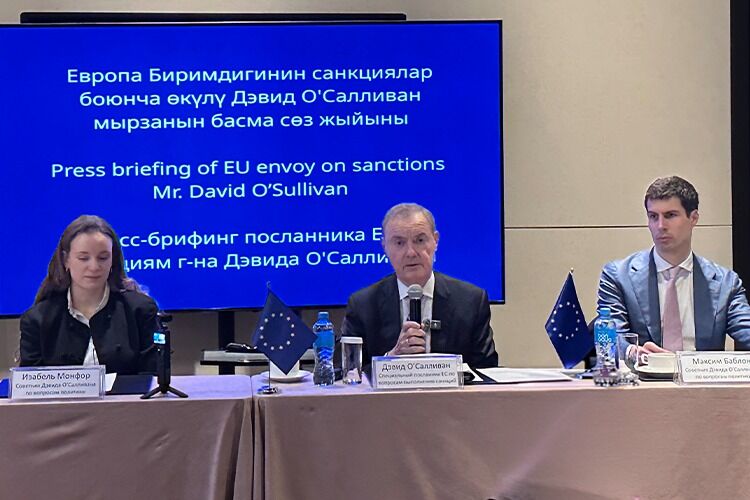
Brussels is concerned about a sharp increase in exports of machine tools and radio equipment over the past year. «They are not produced in Kyrgyzstan but imported from Europe solely for re-export to Russia,» David O’Sullivan stated.
«We are not asking Kyrgyzstan to accept our sanctions. We are asking it not to allow its territory to be used to circumvent them. The goods in question account for a tiny share of trade and bring no economic value to Kyrgyzstan — they are neither produced nor consumed here, they are simply shipped onward. We believe preventing such circumvention will not result in economic losses for the country,» he said.
According to him, compared to the pre-war period, supplies have increased by hundreds of percent. Even small volumes of inexpensive components, he noted, can be used in the production of drones, and missiles and this abnormal growth is something EU representatives are sharing with the Kyrgyz authorities.
The EU has concerns about Kyrgyzstan’s financial system, which led to the inclusion of several banks and cryptocurrency transactions in the 19th sanctions package.
David O’Sullivan
«Regarding the banks: we imposed sanctions on two banks. It is important to understand these are not sanctions against their activities within Kyrgyzstan. It is a ban on transactions with European banks, effectively disconnecting them from SWIFT,» David O’Sullivan explained.
He stressed that correspondent banking bans are introduced based on solid evidence and in the interest of EU national security.
We respect Kyrgyzstan’s sovereignty and its traditional relations with Russia. We are not asking it to stop trading with Russia, nor do we object to remittances from migrant workers — that is legal.
David O’Sullivan
«We only ask that trade relations not involve deliberate circumvention of sanctions through the supply of European dual-use goods,» he noted.
David O’Sullivan added that the EU does not impose sanctions on countries. «We impose them on companies or banks. Recently, banks in China were targeted. We have a good dialogue with Kazakhstan—they have taken significant measures to prevent the transit of military goods. Our decisions depend on an analysis of trade flows, not on political choices favoring one country or another,» he stated.
The Sanctions Envoy said he had met with representatives of the National Bank and the Ministry of Economy, with further talks scheduled at the Presidential Administration and the Cabinet of Ministers.
We understand that the Kyrgyz authorities have already taken certain steps and we expect further progress.
David O’Sullivan
He stressed that since 1991, the European Union has provided Kyrgyzstan with around €600 million in grants and more than €1 billion in loans, including funding for major hydropower projects.
«The European Union attaches great importance to relations with the Kyrgyz Republic. In 2025, we signed an Enhanced Partnership Agreement. Bilateral trade turnover amounted to €3 billion,» he concluded.
Sanctions timeline
Due to suspicions of circumventing restrictions against Russia, companies from other countries, including Kyrgyzstan, began to fall under EU and U.S. sanctions.
- In November 2025, Capital Bank of Central Asia and A7 cross-border payments platform were placed under Canadian sanctions.
- In October 2025, the European Union added two Kyrgyz banks — Tolubay and Eurasian Savings Bank — to such lists.
- In August 2025, Kyrgyzstan’s Capital Bank and the cryptocurrency exchanges Grinex and Meer were placed under British restrictions (previously by the U.S.).
- In February 2025, Keremet Bank, previously included on the U.S. list, was placed under UK sanctions.
- The first sanctions against several private companies from Kyrgyzstan were imposed in June 2024 by the U.S. and UK.
Kyrgyzstan has repeatedly described sanctions against its banks as unfounded. President Sadyr Japarov, speaking at the UN in 2025, criticized Western sanctions against the republic, calling them unjustified interference in internal affairs and pressure hindering the development of a still-emerging economy.