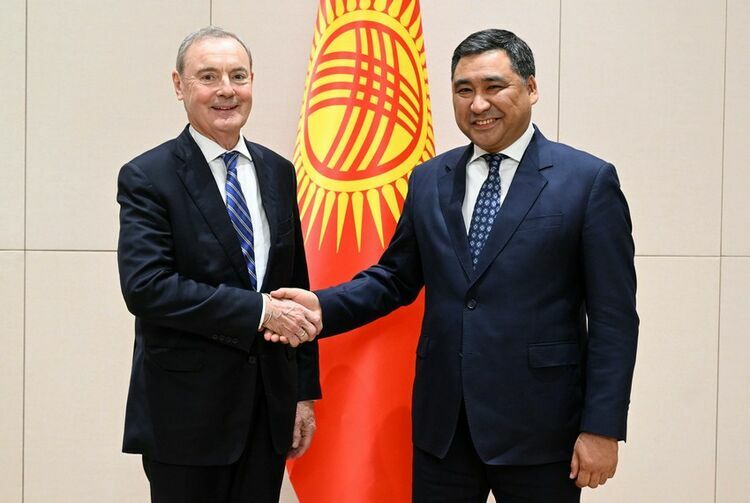
Kyrgyzstan and the European Union will develop a plan to remove the republic’s banks from sanctions lists. The agreement was reached during an expanded meeting of the First Deputy Chairman of the Cabinet of Ministers Daniyar Amangeldiev with EU Sanctions Envoy David O’Sullivan.
The parties exchanged views on compliance with restrictive measures. Daniyar Amangeldiev stated that Kyrgyzstan applies a professional risk management approach and consistently strengthens its financial monitoring mechanisms.
The Kyrgyz side emphasized that European exporters should also bear responsibility for supply chain integrity by thoroughly verifying their counterparties and the end use of goods.
Special attention was paid to the banking sector. Cabinet representatives informed the EU Envoy about the blocking of suspicious transactions in commercial banks and the tightening of oversight procedures.
To improve coordination, the sides proposed developing transparent risk assessment criteria and establishing prompt feedback mechanisms.
The parties outlined a phased plan to resolve issues related to restrictions imposed on certain financial institutions in Kyrgyzstan.
David O’Sullivan praised the openness of the republic’s authorities, noting that transparency is key to building trust with the international community. He presented specific proposals for technical cooperation aimed at removing banks from sanctions lists and minimizing future risks. The meeting concluded with both sides confirming their readiness to maintain regular working contacts.
Sanctions timeline
Amid suspicions of circumvention of sanctions against Russia, companies from various countries, including Kyrgyzstan, have been targeted by EU and U.S. restrictions.
- In November last year, Capital Bank of Central Asia and the cross-border payments platform A7 were placed under Canadian sanctions.
- In October 2025, the European Union added two Kyrgyz banks — Tolubay Bank and Eurasian Savings Bank — to its sanctions list.
- In August last year, the United Kingdom imposed restrictions on Capital Bank, as well as cryptocurrency exchanges Grinex (previously sanctioned by the U.S.) and Meer.
- In February 2025, Keremet Bank, previously included in the U.S. sanctions list, was also sanctioned by the United Kingdom.
- The first sanctions against several private Kyrgyz companies were introduced by the United States and the United Kingdom in June 2024.
Kyrgyzstan has repeatedly stated that sanctions against its banks are unfounded. President Sadyr Japarov, speaking at the UN General Assembly in 2025, criticized Western restrictions against the republic, calling what he described as unjustified sanctions interference in the country’s internal affairs and pressure hindering the development of its still-emerging economy.