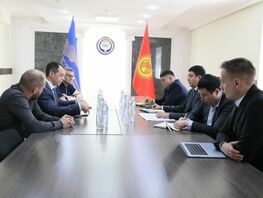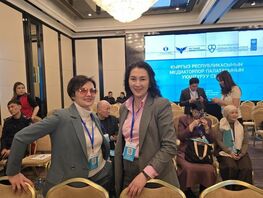


First Deputy Chairman of the Cabinet of Ministers of the Kyrgyz Republic Daniyar Amangeldiev spoke about sanctions, risks, and predictability in an interview with 24.kg news agency.
— Daniyar Dzholdoshevich, one does not need to be an expert to observe that the external environment is becoming increasingly complex. Sanctions are expanding, and rules are changing almost on the fly. Against this backdrop, a natural question arises: How vulnerable is Kyrgyzstan’s economy?
— Any open economy is sensitive to changes in the global regulatory environment. Kyrgyzstan is no exception. However, in my view, the issue is not so much vulnerability as the quality of risk management.
From the outset, we proceed from the understanding that the sanctions environment is not political rhetoric but a legal and financial reality that should be addressed professionally. Therefore, our task is not to produce emotional reactions but to build a system of preventive adaptation: transparent settlements, proper logistics, compliance procedures, and continuous dialogue with regulators and partners.
For a small economy, this primarily means discipline. Not loud decisions, but precision and carefully calibrated steps. The more accurately and deeply you understand the rules, the less room there is for crisis.
— Before we go further, could you clarify what you mean by a «small economy»?
— This is not a value judgment, but an economic term. A small economy is one with a relatively limited domestic market, a high degree of openness, and significant dependence on foreign trade, financial flows, and logistics routes. In such economies, external decisions — regulatory, sanctions-related, or trade-related — are felt more quickly. They are more sensitive than large states with diversified domestic demand.
However, a small economy also has its advantages. It is more flexible. It can adapt more quickly. It is easier for a small economy to adjust its model without dismantling large-scale internal structures. In this sense, «small» does not mean weak. It means more sensitive to the external environment and, accordingly, more demanding in terms of governance quality.
For us, it is not a question of scale but of efficiency. The more compact the system, the higher the importance of precise decisions.
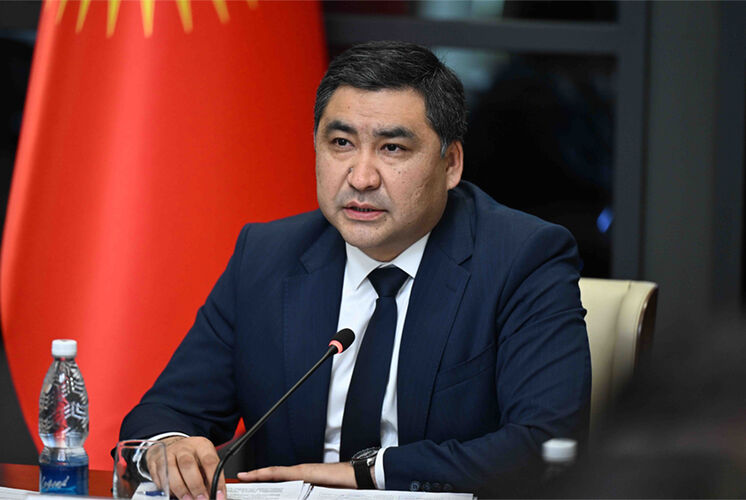
— Okay, let us return to sanctions, particularly the new ones. At the end of January, global media outlets, including Bloomberg, reported that the European Union is considering including Kyrgyzstan in its next sanctions package. How serious is this risk?
— We are closely monitoring the discussions around new EU sanctions packages. When a country is actively involved in foreign trade and transit, the risk of being mentioned in such discussions always exists. This is part of the modern global economy.
It is important to understand that sanctions are a regulatory instrument, not a chaotic or arbitrary process. They are based on procedures, assessments, and evidence. Our task is to operate precisely within that framework.
We are building a systemic risk-minimization model: explanatory work with businesses, strengthening financial monitoring, engagement with European institutions, and increasing transparency of export operations. Kyrgyzstan’s position is extremely pragmatic — we are interested in a predictable and transparent economic model.
Any decisions should be based on objective data, not assumptions.
Daniyar Amangeldiev
For us, it is fundamentally important to maintain the reputation of a responsible and predictable partner.
— And is it working? As far as I know, you are closely involved in the sanctions negotiations. Could you share some of behind-the-scenes secrets?
— There are no special secrets, but even if there were, sanctions diplomacy is not about publicity. It is about careful wording, precise calculations, and understanding the consequences of every step.
Such negotiations are always a team work. We operate within the strategy defined by the country’s leadership. My role is to ensure the professional component of the process — economic analysis, legal expertise, and technical correctness of decisions.
— Kyrgyzstan is increasingly being called a bridge between different economic spaces. Is that a deliberate strategy?
— I would call it pragmatism. Geographically and historically, we are at the crossroads of trade routes. Our task is to use this position rationally — to develop logistics, ensure financial transparency, and reduce transaction costs.
The role of a bridge, in the sense you mention, is not a geopolitical ambition but an economic function. It requires precision, financial transparency, and strict compliance with international standards. A bridge is only stable when it can be safely crossed.
— Clearly, you are a team player, a technocrat, a negotiator. How would you describe yourself?
— Simply put, I am a system person. I am drawn to the logic of precise decisions. Government work, for me, is responsibility for the consequences — not for headlines, but for results.
— And what does responsibility as a state official mean to you?
— Responsibility is the ability to think one step beyond the applause. Government work is rarely flashy. Most often, it is a choice between what is fast and what is right. Almost always, the right decision is less spectacular.
We live in a time when publicity often drowns out substance.
Daniyar Amangeldiev
But the economy still obeys simple laws — trust is built over years and destroyed in minutes.
To put it simply, my task is to ensure that in five or ten years, the decisions we are making today will look not bold, but reasonable.
— And the last question. Putting aside the current agenda—sanctions, negotiations, risks—what is the main challenge for Kyrgyzstan today?
— I would say the main challenge is learning to maintain internal composure in a world that constantly provokes sharp reactions.
Small states often live in a reaction mode — to respond faster, louder, harsher. But stability is built not so much on the speed of reaction as on the quality of decisions.
A country’s strength is not in being visible at any cost. Strength lies in predictability. In the ability to keep one’s word.
Daniyar Amangeldiev
It lies in ensuring that partners understand: if Kyrgyzstan declares something, it is not a situational stance, but a well-thought-out strategy. It lies in the ability to avoid emotional reactions, even when there is a great deal of noise around.