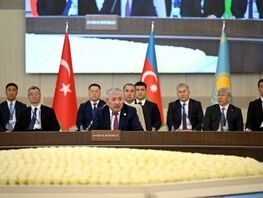


Kyrgyzstan is at the center of the International Atomic Energy Agency’s (IAEA) updated strategy for the remediation of uranium legacy sites in Central Asia for 2025-2030. The document was presented last year at a meeting of the Coordination Group for Uranium Legacy Sites (CGULS) in Tashkent.
It emphasizes that a significant part of the dangerous uranium legacy from the Soviet era is concentrated in the country, located in mountainous and seismically active areas, often near rivers and populated areas. The IAEA clearly states that without systematic and complete remediation, the release of radioactive and toxic substances is a matter of time, not probability.
According to the agency, uranium has been mined in Kyrgyzstan since the mid-1940s, and after the collapse of the USSR, dozens of tailings dumps, waste heaps, and mines were left without proper oversight. In recent years, the republic has demonstrated some of the most significant progress in the region.
Work at Shekaftar and Min-Kush sites, including the reclamation of tailings dams, has been fully completed, and the most complex section, Mailuu-Suu, has been in the active phase since August 2023. According to the IAEA plan, reclamation there will continue until 2032.
The total cost of the entire uranium site cleanup program in Central Asia is estimated at €113 million.
By 2025, €71.8 million has been secured, €61.5 million of which was provided by the European Union. However, a funding gap of approximately €43 million remains, and without this gap, the completion of all priority projects remains at risk. The document states that Kyrgyzstan’s own resources are insufficient to fully resolve the problem, and international support remains critically important.
The new plan places special emphasis on sites that were previously not considered a priority. For Kyrgyzstan, this concerns Kadzhi-Sai, Tuya-Moyun, and Kyzyl-Dzhar. Their reclamation is planned under a bilateral agreement with Russia, for which funding of €21.4 million has been approved. These projects are scheduled to begin after work at the main priority sites is completed.
The IAEA notes that reclamation is only part of the task.
After the completion of construction and engineering work, Kyrgyzstan will be responsible for decades of radiation and environmental monitoring, institutional oversight, and the safety of the cleaned-up areas.
The new strategic plan effectively cements the republic’s status as one of the key countries in the region in terms of the scale and complexity of its uranium legacy, resolution of which directly linked to international solidarity and the state’s long-term responsibility.