


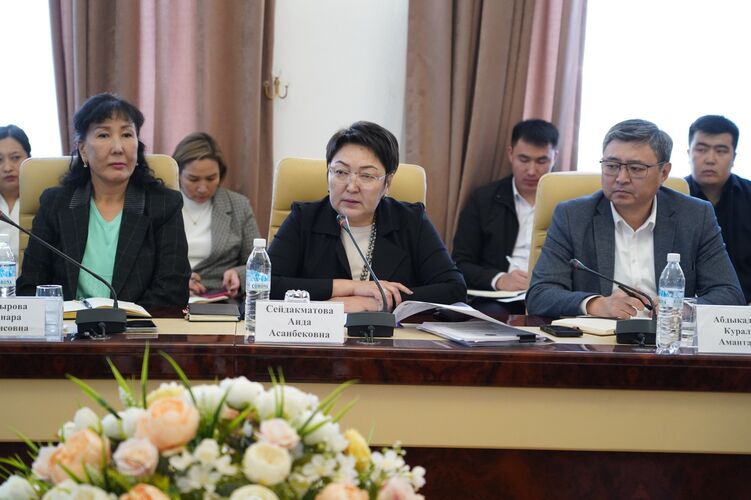
A meeting of the commission for the analysis and optimization of the structure of courts and the number of judges was held at the Supreme Court of the Kyrgyz Republic. The meeting was chaired by Aida Seidakmatova, Chair of the Council of Judges and a Supreme Court judge.
This commission was formed on October 17 by a decision of the Council of Judges to implement Part 3 of Article 2 of the Constitutional Law «On Amendments to the Constitutional Law «On the Supreme Court and Local Courts of the Kyrgyz Republic,’» signed by the President of the Kyrgyz Republic on October 9, 2025, No. 207.
Meeting participants discussed issues related to the review and optimization of the structure and number of judges in the republic. Based on the commission’s findings, proposals will be developed for consideration by the President.
The adopted law provides for the establishment of the court structure and the number of judges not by law, but by presidential decree. This measure will help ensure an even distribution of the workload among judges, the rational use of the judicial system’s human and logistical resources, and increase the efficiency of judicial operations.
Specifically, according to judicial statistics, the total number of court cases and materials submitted to the Supreme Court for review was 4,566 in 2010, 5,565 in 2020, and 7,829 in 2024.
Thus, the workload of Supreme Court judges has increased by more than 40 percent compared to 2010. The number of Supreme Court judges, including the chief justice and his deputies, has remained unchanged at 35 since 2003. Over the past five years, the number of cases and court materials received by first-instance courts has doubled: from 125,285 in 2020 to 251,620 by the end of 2024. This trend demonstrates the need for systemic measures to optimize the structure of the judicial system, more rationally distribute the workload among judges, and increase the number of judges in the courts with the heaviest workloads.
The issue of increasing the number of local court judges in the newly enlarged administrative-territorial units is also particularly pressing, driven by the adoption of the Law «On Administrative-Territorial Units at the Level of Aiyl Aimaks and Cities of the Kyrgyz Republic.» Changes to district and city boundaries have led to the expansion of individual administrative-territorial units and population growth, which, in turn, has significantly increased the workload of judges.