
“Politics is like orchestra.” Exclusive interview with Swiss Parliament Speaker
Switzerland is ready to expand cooperation with Kyrgyzstan in hydropower, natural disaster prevention, the financial sector, and agriculture. Pierre-André Page, President of the National Council of the Swiss Federal Assembly, spoke to 24.kg news agency in an exclusive interview about Kyrgyzstan, investment, hydropower, and bilateral cooperation.
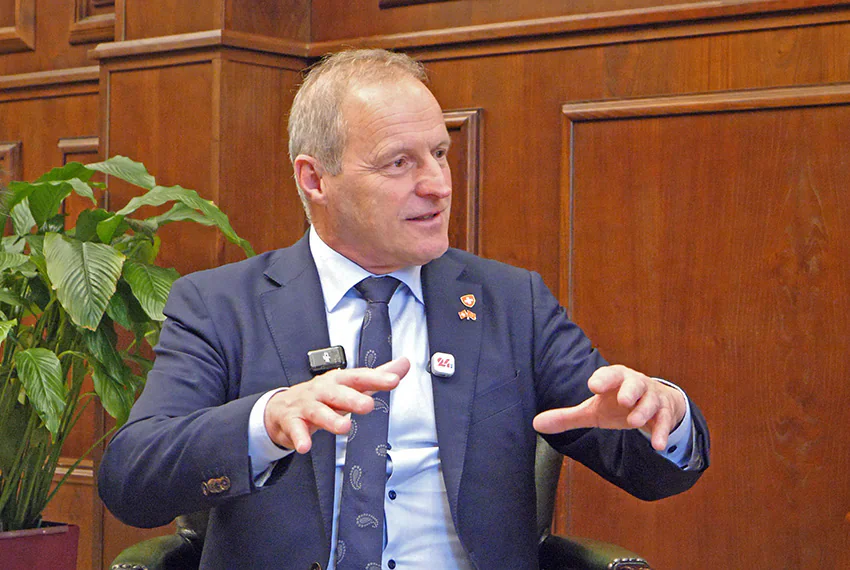
The Swiss politician arrived in Kyrgyzstan at the invitation of KSB Commercial Bank. His visit, however, was not only political but also musical. Pierre-André Page heads the renowned Swiss wind orchestra La Landwehr de Fribourg, which has a history spanning more than 200 years and performed in Central Asia for the first time.
In the interview, he explained why he believes parliament is like an orchestra, what makes Kyrgyzstan attractive to Swiss investors, why the future of energy should not be tied exclusively to large-scale dams, and what opportunities Kyrgyzstan's agricultural sector offers for cooperation.
— Mr. Page, this is not your first visit to Kyrgyzstan. What are your impressions of our country?
— First of all, I was deeply impressed by the extraordinary welcome we received from the Kyrgyz people. It was a truly emotional experience to feel the friendship that comes so naturally from people. We were welcomed with exceptional warmth.
— You are involved in both politics and music. What is more difficult: leading a parliament, where everyone plays their own part, or conducting an orchestra, where everyone must follow the same score? And what could politics learn from a good orchestra?
— First of all, it is important to understand that almost all the musicians in our orchestra are amateurs. Only the conductor is a professional. For the others, music is a passion. We meet every week for rehearsals and then perform together at various events.
There is indeed a connection between music and politics.
As president of the National Council, I work with people who hold very different views and ideas. An orchestra also has different instruments, each with its own sound. But all these sounds need to be brought together to create something beautiful.
Politics works in much the same way. In music, when someone plays too loudly, they are told «piano» — play more softly.
In politics, when someone speaks too loudly, they need to be told: «Please listen to others as well.»
I think this is precisely where music and politics are very similar.
— Kyrgyzstan is seeking to attract more European investment. However, investors are interested in more than just tax incentives; they also care about property rights protection, the judicial system, and the predictability of regulations. How does the Swiss business community view Kyrgyzstan, and what needs to be done to attract mor e substantial capital?
— Cooperation between Switzerland and Kyrgyzstan has a fairly long history. Swiss experts have been working with your country for around 35 years.
Today, our task is to develop these relations and help Swiss investors enter the Kyrgyz market.
For example, Switzerland has extensive expertise in hydropower. Kyrgyzstan, too, can significantly expand its use of hydropower resources.
In addition, our countries face similar challenges associated with mountainous terrain, including rockfalls, landslides, and other natural hazards.
Switzerland can share technologies for risk prevention, monitoring systems, and early warning systems to alert the public.
There are therefore many areas in which we can strengthen cooperation. Here again, we can draw an analogy with music: we need to talk to each other, find common ground, and move forward together.
— Kyrgyzstan and Switzerland have economies of different sizes, but both are mountainous and landlocked. What Swiss experience could Kyrgyzstan adopt? And are there solutions that should not simply be copied?
— First and foremost, I would highlight our experience in water resource management and safety in mountainous areas.
But Switzerland does not want to come to Kyrgyzstan and tell you how to live or what to do. Your people are hardworking and know how to do their jobs well. We have certain approaches and technologies that differ from yours.
Cooperation should be built precisely in this way — not by imposing someone else's model, but through sharing experience and finding solutions that benefit both sides.
— You mentioned hydropower. A small hydropower plant project on Turgen River in Kyrgyzstan is already being implemented with Swiss capital. Why is this particular sector of interest to Switzerland?
— One thing is important to understand here. If you have one large power facility and it breaks down, a serious problem arises: electricity generation stops.
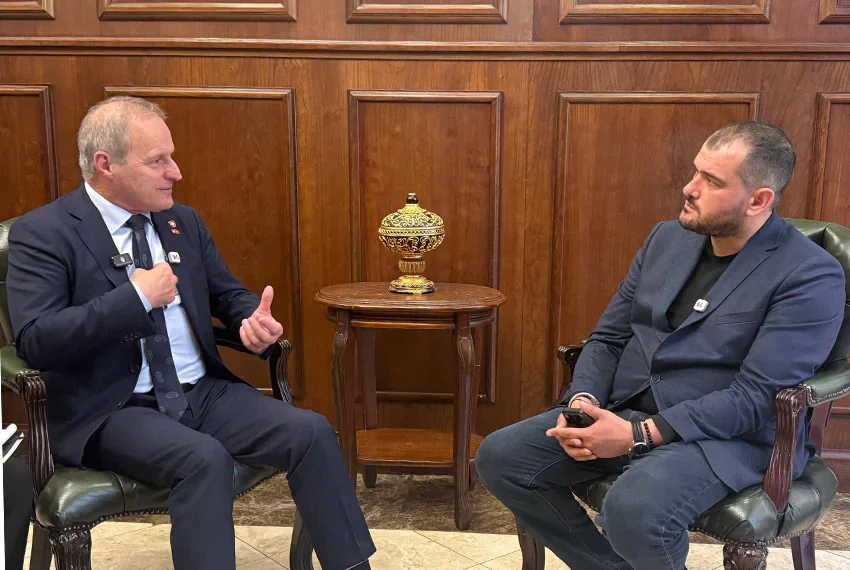
That is why it is very important to have several smaller facilities operating in parallel and complementing one another.
If one small power plant stops functioning for some reason, the others can continue generating electricity. If a major accident occurs at the only large dam, the consequences for energy supply could be much more far-reaching.
The main task is to ensure that people have reliable access to electricity. That is precisely why I see the development of a network of small hydropower plants as a promising direction.
— What other Swiss projects could emerge in Kyrgyzstan? Where do you see the next major areas of cooperation?
— I would highlight hydropower and natural disaster prevention above all.
In Switzerland, we have experience in monitoring natural hazards, including glacier movements. When specialists detect that a glacier is shifting and a danger is emerging, the population needs to be warned in time and evacuated if necessary. Similar systems could also be introduced in Kyrgyzstan to prevent tragedies and reduce the impact of natural disasters.
The third area is the financial sector.
Switzerland is already represented in Kyrgyzstan, including through KSB Commercial Bank, a closed joint-stock company with Swiss capital, which is operating successfully here.
But I would also like to mention another sector that is particularly close to my heart.
— Which one?
— Agriculture. My original professional training was in farming. I worked in agriculture myself.
In Kyrgyzstan, I saw vast expanses of land and beautiful pastures. In Switzerland, we produce milk and cheese. We have accumulated extensive experience in this field, developed efficient technologies, and achieved good results.
This would enable agricultural producers to earn higher incomes. As someone who has worked as a farmer, I can say that Kyrgyzstan definitely has investment potential in this sector.
And I would like to emphasize once again: Switzerland does not seek to teach Kyrgyzstan what it should do.
We can share our experience and show how we address challenges at home. We can then jointly determine which approaches could be applied in the interests of your country.
In my view, this is precisely how cooperation between our countries should develop.


