
Failure to implement UN decisions undermines its legitimacy — Sadyr Japarov
President of Kyrgyzstan Sadyr Japarov addressed the 81st session of the UN General Assembly.
He identified the «weakness of effective mechanisms for ensuring the implementation of the decisions of the Organization» as one of the problems.
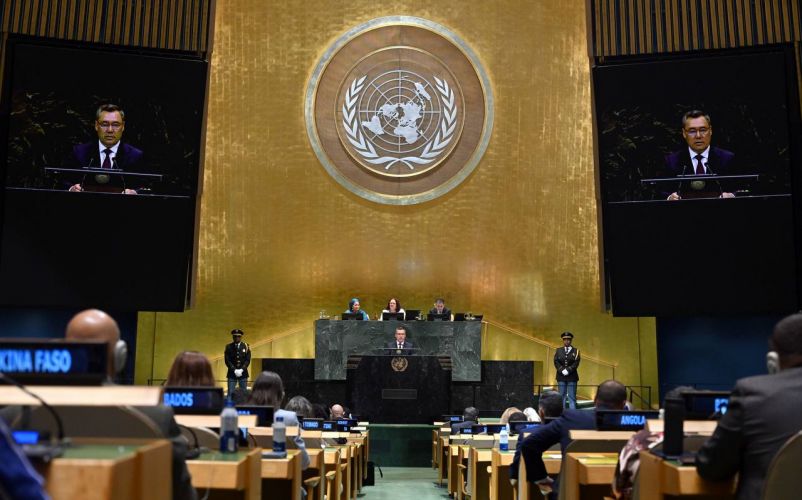
«The systematic failure to implement the Organization’s decisions undermines the legitimacy of multilateralism’s concept, creates the impression that international law is not binding, and encourages disregard for international obligations. Therefore, we must expand and strengthen the authority of the United Nations,» the Head of State said, proposing the redevelopment of the United Nations mechanism for the implementation of decisions and accountability.
According to him, first and foremost, it is necessary to establish, within the framework of the General Assembly, the permanent public registry of the implementation of resolutions and obligations by Member States.
This registry could include the following information and ensure the implementation of such measures as:
- The first — systematically record and verify the level of implementation of adopted decisions.
- The second — establish the obligation for Member States to regularly submit report in accordance with agreed standards.
- The third — provide analytical reviews on sectors and regions.
- The fourth — ensure transparency and equal access to information for all states.
The registry could be administered by the United Nations Secretariat, with the support of independent experts, Sadyr Japarov believes.
If decisions of the Organization are systematically not implemented, he proposed the gradual response mechanism.
The first stage — an official notification to the concerned State, followed by consultations with the relevant bodies of the Organization. The second stage — the deployment of a monitoring mission to the country concerned to assess the objective obstacles preventing the implementation of the decisions and to prepare recommendations. The third stage — consideration of the case — right here — at a plenary meeting of the General Assembly to determine the status of the concerned State in terms of its systematic implementation or non-implementation of United Nations decisions.The fourth stage — the initiation of appropriate procedures under the Charter of the United Nations with regard to States that fail to comply with the requirements.
In particular, the matter could be referred to the United Nations Security Council for consideration of restrictive measures provided for under international law, including:
- temporary restrictions on participation in United Nations programs;
- recommendations to review existing formats of cooperation.
- other diplomatic measures, where appropriate.
If a mechanism designed to ensure the implementation of the Organization’s decisions is systematically blocked by permanent members through the use of the veto, such practice would no longer be consistent with the spirit of the UN Charter and the principle of equal responsibility of Member States, the head of Kyrgyzstan noted.
I believe that when cases of systematic non-implementation of United Nations’ decisions are considered, the permanent members of the Security Council should voluntarily refrain from using the veto.
Sadyr Japarov
«Therefore, we should once again consider the possibility of voluntarily restraining the use of the veto in matters related to the implementation of the Organization’s decisions. This approach could promote universality, the equality of all states regardless of their size, the primacy of diplomacy and avoid the double standards,» he added.
President proposed establishing the open working group within the General Assembly with the participation of the interested Member States. The working group could conduct intergovernmental consultations and prepare a report on possible models for the proposed mechanism.
Following these consultations, the General Assembly and the Security Council should consider adopting the relevant resolutions and decisions, Sadyr Japarov said.
The strategic objective of this initiative is to ensure that the decisions of the Organization are treated not merely as political recommendations, but as genuine international obligations. Improvement of their implementation would strengthen the rule of international law and reinforce confidence in the United Nations.
Kyrgyzstan is ready to initiate interstate discussions on the development of such a mechanism.
According to the Head of State, starting from January 1, 2027, as a member of the United Nations Security Council, the republic intends to formally submit all these proposals to the relevant Committee.


