
Kyrgyzstan faces climate crisis — glaciers melt, damage runs into billions
The Cabinet of Ministers has submitted for public discussion a draft National Adaptation Plan of the Kyrgyz Republic through 2035. The document calls for a large-scale overhaul of the country’s climate risk management system, covering everything from water and agriculture to infrastructure, healthcare and the protection of communities.
The document notes that climate change is no longer an abstract threat for Kyrgyzstan. More than 90 percent of the country’s territory lies at elevations above 1,000 meters, while about 40 percent is above 3,000 meters. A significant share of river runoff is generated by glaciers and seasonal snow, meaning climate change directly affects water supplies, irrigation and hydropower.
Temperatures in Kyrgyzstan are rising at an accelerating rate. Between 1981 and 2020, the average annual temperature increased by approximately 0.28 degrees Celsius per decade.
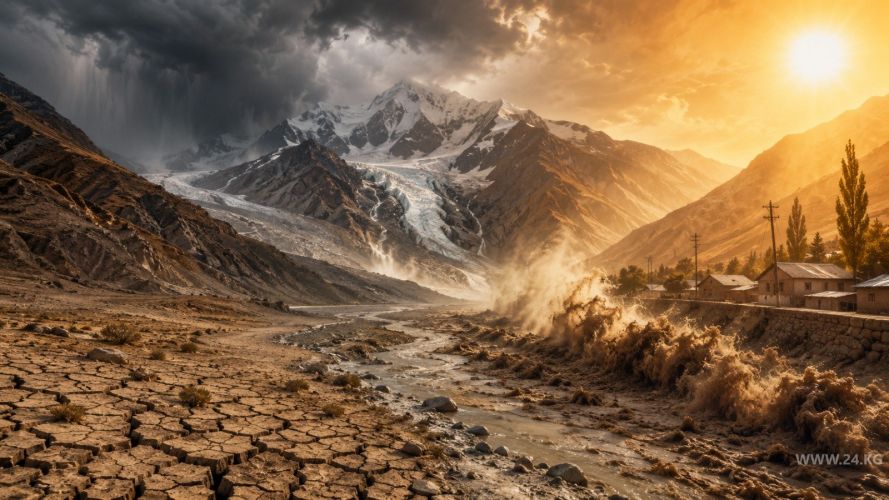
The area covered by glaciers has declined by 16–17 percent since the beginning of the 21st century. Even without additional warming, the volume of glaciers could shrink by another 36 percent by 2050, according to the plan’s authors. The number of glacial lakes in the northern Tien Shan has increased by about 30 percent, raising the risk of glacial lake outburst floods.
The consequences are already costing the country dearly. Between 2015 and 2022, Kyrgyzstan recorded 986 emergencies, 319 of which were related to mudflows and floods. Direct damage from such disasters exceeded 15 billion soms over the 10-year period through 2023.
Another alarming indicator is water loss. In 2024, about 26 percent of the water withdrawn from natural sources was lost during transportation.
By the middle of the century, up to 24 percent of demand for irrigation water could remain unmet. Without action, climate-related losses could amount to 2–3 percent of GDP by 2040 and up to 4.2 percent by 2050, while another 170,000 people could fall below the poverty line.
The plan through 2035 identifies six main areas:
- water security;
- sustainable agriculture;
- restoration of forest and mountain ecosystems;
- protection of infrastructure and settlements;
- disaster risk management;
- adaptation of the healthcare and social protection systems.
Particular emphasis is placed on water. The plan calls for reducing losses in irrigation and drinking water infrastructure by at least 30 percent by 2035, providing at least 80 percent of vulnerable areas with early warning systems for water shortages and droughts, and introducing climate-resilient water management practices on at least 25,000 hectares of agricultural land.
In agriculture, the authorities intend to reduce the share of degraded pastures from 42 percent to 30 percent, bring at least 150,000 hectares under climate-resilient and water-saving technologies, and ensure that most rural households in high-risk areas receive at least one form of adaptation support.
For infrastructure, the plan calls for mandatory climate screening of new facilities, the protection or modernization of at least 250 critical facilities in high-risk areas, and restrictions on construction in hazardous zones without an assessment of climate-related risks.
Early warning systems are expected to cover at least 90 percent of high-risk settlements, while 2,500 specialists are to be trained to respond to climate-related emergencies.
The document also provides forecasts for public health. Without adaptation measures, the incidence of waterborne infections could increase by 10–17 percent, while heat-related illnesses could rise by 55–94 percent. Additional healthcare costs could amount to approximately $6.7 million per year.
Specific measures are planned for individual regions. In Batken region, the priority will be addressing water shortages; in Jalal-Abad region — protecting against landslides, floods and mudflows; in Issyk-Kul region — protecting coastal areas and utility infrastructure; and in Naryn region — improving pasture resilience and reducing livestock losses. In Bishkek and Osh, the plan calls for taking extreme heat, pressure on utility systems and heavy precipitation risks into account.
The overall funding requirement for the National Adaptation Plan for 2026–2035 is estimated at 74.5 billion soms.
Of this amount, 53.6 percent is expected to come from international partners and climate funds, 22.3 percent from the national budget, 14.2 percent from local budgets and 9.9 percent from businesses.
After the plan is approved, the Ministry of Natural Resources will have six months to establish an interagency working group and develop a specific action plan.


