
Nearly 1,400 years later in Xuanzang’s footsteps: Koichiev on Xi Jinping’s visit
State Secretary of Kyrgyzstan Arslan Koichiev drew a symbolic historical connection between Chinese President Xi Jinping’s current state visit to Kyrgyzstan and the journey of the renowned Chinese monk Xuanzang through Central Asia nearly 1,400 years ago.
In a post on social media, Koichiev highlighted the place where the Chinese leader stayed and an article Xi Jinping published ahead of his visit.
«Nearly 1,350 years later, President Xi Jinping followed in the footsteps of Xuanzang, whom he himself mentioned, stopped at exactly the place where Xuanzang had stayed, and rested there. This cannot but inspire admiration,» Koichiev wrote.
He is referring to Bas-Boltok (Boz-Boltok) area near the village of Baytik, where state residences are located.
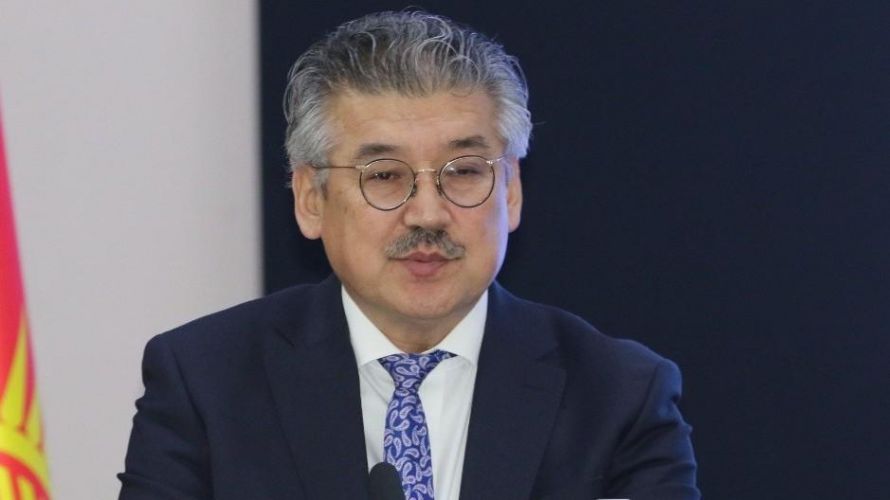
Koichiev recalled that ahead of his trip to Bishkek, Xi Jinping published an article on Kyrgyzstan — China relations. The article, titled «Jointly Opening up New Prospects for the High-Quality Development of China-Kyrgyzstan Relations,» was published on August 28 in Slovo Kyrgyzstana and by Kabar national news agency.
In the article, Xi Jinping specifically referred to the centuries-old history of contacts between the peoples of the two countries.
«To this day, both countries cherish fond memories of Zhang Qian, Xuanzang, Li Bai and other prominent figures who contributed to civilizational exchanges between China and Kyrgyzstan,» the Chinese president wrote.
It was Xi’s mention of Xuanzang, Arslan Koichiev said, that drew his attention to the historical coincidence.
Who is Xuanzang?
Xuanzang is one of the best-known Chinese Buddhist monks, travelers and translators of the 7th century. In 629, he left China on a long journey to India in search of Buddhist manuscripts.
His route took him through Central Asia. He crossed the Tien Shan mountains, visited the Issyk-Kul area and Suyab state, and then continued westward. He returned to China in 645.
His observations later formed the basis of the famous work Da Tang Xiyu Ji, orThe Great Tang Records of the Western Regions. For historians, the work became one of the most important written sources on Central Asia in the 7th century.
Xuanzang provided detailed descriptions of the cities, natural environment, population, customs and political structures of the lands he visited.
Suyab occupies a particularly important place in his account. It was a major city along the Silk Road, with its remains associated with Ak-Beshim archaeological site near present-day Tokmok. From Suyab, Xuanzang continued westward.
Min-Bulak — «Thousand Springs»
This is where the historical connection highlighted by Arslan Koichiev begins.
According to Xuanzang’s account, approximately 400 li west of Suyab, the traveler reached a place known in Chinese sources as Qianquan, meaning «Thousand Springs.» In Turkic tradition, the name is rendered as Min-Bulak.
One of the classical English translations of Xuanzang’s records says that the area of Min-Bulak extended for about 200 li. It was bordered by snow-capped mountains to the south, while the remaining three sides were flat.
The traveler described numerous springs and bodies of water, abundant vegetation and a cool climate. In spring, the area was covered with flowers.
The location was so well suited for a summer retreat that, according to Xuanzang, the Turkic khagan came there every year to escape the heat.
His records also mention herds of domesticated deer. Some of the animals wore bells and rings. The khagan prohibited their killing, allowing them to roam freely in the area. Such a description is indeed found in classical translations of the Chinese traveler’s work.
Another biography of Xuanzang likewise says that after traveling approximately 400 li westward, he reached Bingyul, the «Thousand Springs» (Min-Bulak). The area was described as cool, covered with forests and numerous bodies of water, and as a place where the Turkic khagan spent the summer months. Xuanzang then continued toward Talas.
How Koichiev connects Min-Bulak with Bas-Boltok (Boz-Boltok)
Arslan Koichiev writes that researchers have compared the distance given by Xuanzang with his geographical description and concluded that Min-Bulak may have been located at the foot of present-day Bas-Boltok (Boz-Boltok), in the area of Baytik village.
«Snow-white mountains lie to the south, while plains stretch in three directions,» the state secretary quoted Xuanzang as writing.
According to Koichiev, state residences, including Yntymak Ordo and Yrys Ordo, are located in this area today.
This is the basis for Koichiev’s historical parallel: nearly fourteen centuries later, the Chinese leader found himself in a place that he associates with the stay of one of China’s most famous travelers.
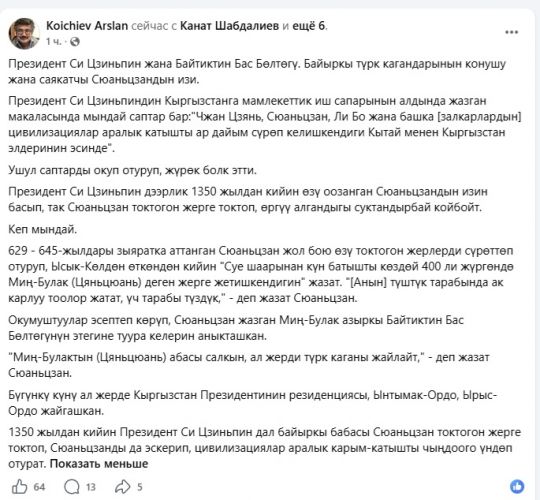
«1,350 years later, President Xi Jinping stopped exactly where his ancient compatriot Xuanzang had stayed, recalled Xuanzang and called for stronger intercivilizational ties,» Koichiev wrote.
At the same time, the exact location of Min-Bulak described by Xuanzang remains a subject of scholarly debate. One research theory links it to Baytik intermontane depression at the foot of the Kyrgyz Range, but other possible locations exist.
Xi Jinping visits Kyrgyzstan for third time
Chinese President Xi Jinping and his wife arrived in Bishkek on August 30 for a state visit. They were welcomed at Manas International Airport by President Sadyr Japarov and First Lady Aigul Japarova.

This is Xi Jinping’s third visit to Kyrgyzstan and his first in seven years. The Chinese leader will also attend the meeting of the Council of Heads of State of the Shanghai Cooperation Organisation in Bishkek.
Even before his arrival, Xi Jinping emphasized the centuries-old foundations of relations between the two countries. In his article, he described the ancient Silk Road as evidence of the longstanding friendship between the peoples of China and Kyrgyzstan, and the stories of Zhang Qian, Xuanzang and Li Bai as part of the shared heritage of intercivilizational contacts.
Arslan Koichiev’s observation therefore adds another dimension to the current visit—a historical one: the modern diplomatic meeting between the two countries has been superimposed on the route traveled by explorers of the Great Silk Road more than a thousand years ago.


