
Scientists sequence DNA of ancient Saka people from burial site in Kyrgyzstan
An international team of researchers has sequenced the DNA of ancient Saka individuals buried at the Boz-Barmak cemetery in Kyrgyzstan, providing new insights into their ancestry, kinship, and social organization. The findings were published in the journal Scientific Reports.
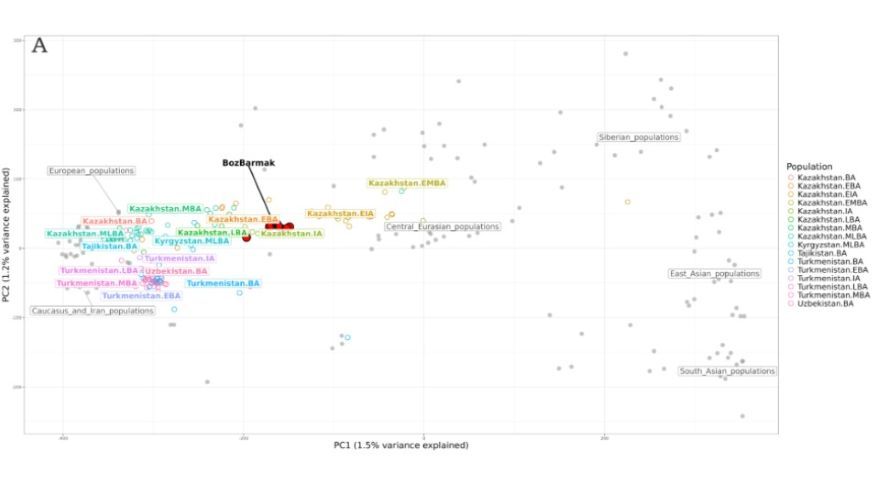
The study analyzed the remains of 12 individuals recovered from the recently excavated Boz-Barmak burial ground, which dates to the 4th—2nd centuries BC. Researchers successfully reconstructed the genomes of nine individuals at low coverage.
The archaeological site was discovered in 2022 during the construction of Balykchy—Kochkor railway near Issyk-Kul Lake. Archaeologists identified an Early Iron Age cemetery consisting of a series of burial mounds, which they believe may have been used by the local Saka elite. Most of the graves, however, had been looted in antiquity.
The genetic study was carried out by scientists from Austria, Kyrgyzstan, and the United States, led by Martin Kuhlwilm of the University of Vienna.
Among the nine sequenced individuals, six were women and three were men.
The researchers found no first-degree relatives (such as parents and children or siblings) among the sampled individuals. However, they identified three pairs of second-degree relatives (such as an aunt or uncle and a niece or nephew) and three pairs of third-degree relatives (such as first cousins), indicating that members of the same extended families were buried at the cemetery.
The analysis also found little evidence of close-kin marriages. Most individuals lacked long runs of homozygosity, suggesting that marriages between close relatives were uncommon. In three cases, however, the data indicate that the parents of the individuals may have been distant relatives, roughly equivalent to fourth- or fifth-degree cousins.
Genetic analysis showed that each individual carried a different mitochondrial DNA haplogroup, reflecting high maternal-line diversity. By contrast, all three male individuals shared the same Y-chromosome haplogroup, R1a1a1b2, a lineage that is relatively common among present-day Kyrgyz and Tajik populations.
According to the researchers, the combination of high mitochondrial diversity and low Y-chromosome diversity is consistent with a patrilocal social structure, in which women moved to live with their husbands’ communities after marriage, among Saka groups living in Issyk-Kul region during the Early Iron Age.
The genomic analysis also showed that most of the ancestry of the Boz-Barmak individuals can be traced to earlier nomadic populations from the territory of present-day Kazakhstan and Western Siberia, highlighting strong genetic continuity across the Eurasian steppe.


